2030 VISION FOR ASEAN - CHINA STRATEGIC PARTNERSHIP: Perspectives From Think-Tanks by Fujian Li
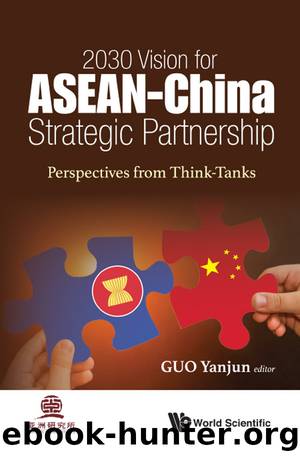
Author:Fujian Li [Li, Fujian]
Language: eng
Format: epub
ISBN: 9789813271586
Google: 1vFOwAEACAAJ
Publisher: World Scientific Publishing Company Pte Limited
Published: 2018-01-15T06:10:43+00:00
III.
Challenges
No one can deny that over the past years, ASEAN and China have enjoyed the most unprecedented relations and cooperation which grew from strength to strength rarely seen in the groupingâs external dialogue. However, both ASEAN and China still went through some difficulties and challenges that need to be resolved in the future.
It has been obviously seen that one of fundamental objectives which have been, for a long time, valued by China in its relations with ASEAN, is to maintain Southeast Asia a peaceful and neutral region, free from dominance by any regional or outside power. However, this policy came up with mix feelings among ASEAN countries, that is, they view China with both suspicious and cautious optimism. The cautious optimism may cause from two reasons â the first reason is that historical precedence due to Chinaâs past support of ethnic insurgent movements in ASEAN members, and another reason is uncertainty or ambiguity of the use of Chinaâs power in regional affairs.
Some ASEAN countries concern about the rise of China. Typically, after the Cold War, Chinaâs peaceful rise since Deng Xiaopingâs bold reforms of 1979 has been a remarkable historical development. Chinese leaders have transformed a poor society by an economic miracle to become now the second-largest economy in the world. Today, China is growing at rates unimaginable 50 years ago, a dramatic transformation no one predicted. The Chinese people have raised their expectations and aspirations. Every Chinese wants a strong and rich China, a nation as prosperous, advanced, and technologically competent as other major countries like America, Europe, and Japan. However, the real big test for China is whether Chinaâs neighbors (some ASEAN countries) can learn to accommodate Chinaâs rise and whether China itself can learn to address its neighborsâ concerns better. Both sides will have to be careful and pragmatic.
There still exist differences of development levels between ASEAN members and China. Most of ASEAN members are undeveloped and developing countries, but China has become an economic giant. These disparities lead to the assumption that the rich will control the poor. This condition will create a negative effect for the cooperation in some ways.
Border and maritime issues between ASEAN countries and china still become a sensitive problem, while Southeast Asia experiences their own internal security issues â particularly conflicts between member states, separatist conflicts, and nontraditional security concerns.
Mutual trust and cooperation in the region is the decisive factor to drive future development of strategic partnership. ASEAN and China have differences from each other in some ways; it is inevitable that perspectives on a particular issue may sometimes be arisen, such as the rise of China and South China Sea issues. It is therefore critical for ASEAN and China to review opportunities and challenges in the past to take foundations for further enhancing mutual trust and confidence, thus creating an environment to further strengthen friendly and good-neighborly relations by working together to overcome current challenges and move ASEANâChina relationship to a higher level.
To help overcome some of these hurdles, it
Download
This site does not store any files on its server. We only index and link to content provided by other sites. Please contact the content providers to delete copyright contents if any and email us, we'll remove relevant links or contents immediately.
Personalized inhaled bacteriophage therapy for treatment of multidrug-resistant Pseudomonas aeruginosa in cystic fibrosis by unknow(214153)
CONSORT 2025 statement: updated guideline for reporting randomized trials by unknow(102519)
Critical evaluation of the ProfiLER-02 study design and outcomes by Vivek Subbiah & Razelle Kurzrock(102042)
Cardiac gene therapy makes a comeback by Oliver J. Müller & Susanne Hille & Anca Kliesow Remes(101836)
Whisky: Malt Whiskies of Scotland (Collins Little Books) by dominic roskrow(74617)
Unveiling the design rules for tunable emission in graphene quantum dots: A high-throughput TDDFT and machine learning perspective by Şener Özönder & Mustafa Coşkun Özdemir & Caner Ünlü(51000)
A yeast-based oral therapeutic delivers immune checkpoint inhibitors to reduce intestinal tumor burden by unknow(40371)
Covalent hitchhikers guide proteins to the nucleus by Alexander F. Russell & Madeline F. Currie & Champak Chatterjee(40295)
Meet the Authors: Christopher R. Mansfield and Emily R. Derbyshire by Christopher R. Mansfield & Emily R. Derbyshire(40204)
Alkaline-earth metals promote propane dehydrogenation with carbon dioxide through geometric effects: Altering the reaction pathway by unknow(32813)
Induced iron vacancies boosting FeOOH loaded on sustainable Fenton-like collagen fiber membrane for efficient removal of emerging contaminants by unknow(32609)
Efficient electric-field-assisted photochemical conversion of methane to n-propanol exclusively over penetrated TiO2Ti hollow fibers by Guanghui Feng(32528)
Bi2SiO5 nanosheets as piezo-photocatalyst for efficient degradation of 2,4-Dichlorophenol by Hangyu Shi & Yifu Li & Lishan Zhang & Guoguan Liu & Qian Zhang & Xuan Ru & Shan Zhong(32465)
A novel NDIPTA organic heterojunction photocatalyst with built-in electric field for efficient hydrogen production by Jiahui Yang & Baojun Ma & Yongfa Zhu(32438)
Enhanced conversion of methane to liquid-phase oxygenates via hollow ferrite nanotube@horseradish peroxidase based photoenzymatic catalysis by Jun Duan & Shiying Fan & Xinyong Li & Shaomin Liu(32404)
Ordered macroporous superstructure of defective carbon adorned with tiny cobalt sulfide for selective electrocatalytic hydrogenation of cinnamaldehyde by Xiao-Shi Yuan & Sheng-Hua Zhou & San-Mei Wang & Wenbo Wei & Xiaofang Li & Xin-Tao Wu & Qi-Long Zhu(32332)
What's Done in Darkness by Kayla Perrin(27246)
Topological analysis of non-conjugated ethylene oxide cored dendrimers decorated with tetraphenylethylene: Insights from degree-based descriptors using the polynomial approach by A Theertha Nair & D Antony Xavier & Annmaria Baby & S Akhila(26628)
Investigation of mechanical and self-healing properties of hydroxyl-terminated polybutadiene functionalized with 2-ureido-4-pyrimidinone by Mohsen Kazazi & Mehran Hayaty & Ali Mousaviazar(26554)
